
It is somewhat old news now, but I would like to discuss the House of Councillors election held on July 20. Following the blunders by the Democratic Party for the People (DPFP) regarding the Yamao issue and other matters, I previously predicted in this blog that “voter turnout would decrease while Reiwa and Sanseito would grow.” As it turned out, public expectation for the DPFP did not wither as much as I had feared, and voter turnout actually increased. Furthermore, both Reiwa and Sanseito expanded as predicted. Consequently, the decline of the “Fiscal Hawks” (財政規律派) became undeniable, while the “Fiscal Expansionists” (積極財政派) made a great leap forward, with their combined vote share in the proportional representation block approaching 40%.
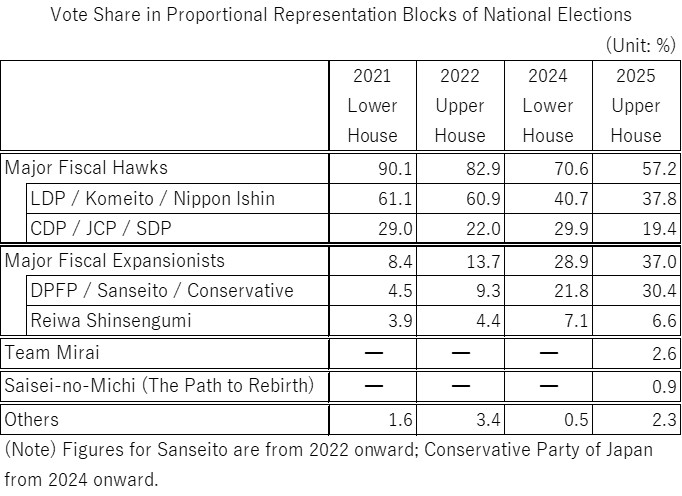
That said, although “Reiwa Shinsengumi” expanded, they only secured 3 seats compared to the 2 that were up for re-election. One would expect a party that resonates with the public struggling under high prices to have performed better—so what happened? The Japanese Communist Party (JCP), which is said to share a similar supporter base, is in decline, so it isn’t a case of being eclipsed by them. I have seen reports suggesting that support flowed to Sanseito, but could that really be the case when, despite both being fiscal expansionists, their political stances are polar opposites?
I suspect the following factors played a larger role. First, the Social Democratic Party (SDP) fielded Mr. LaSalle Ishii, and their vote share recovered by 0.6 percentage points (2.1%) compared to the 2024 general election (1.5%). This aligns quite closely with Reiwa’s 0.5 percentage point drop. Second, the emergence of Takahiro Anno’s “Team Mirai” and Shinji Kanji Ishimaru’s “Saisei-no-Michi” (The Path to Rebirth) likely drew younger supporters away from Reiwa. While the actual dynamics remain unclear, this scenario feels more plausible to me than a shift toward Sanseito.
I recognize Reiwa as genuine fiscal expansionists whose thinking on fiscal policy is close to my own. However, because their political stance leans to the left, it is difficult for them to align with other expansionist groups like Sanseito or the Conservative Party of Japan. While I am not a political commentator and wish to avoid definitive statements, Reiwa’s unexpected stagnation in this election seems to have made it easier for the expansionist camp to consolidate under conservative leadership. They should certainly be able to partner with the right wing of the LDP and the DPFP. Of course, the future of the LDP is uncertain due to internal turmoil, and it remains unclear how the expansionist faction within the Constitutional Democratic Party (CDP) will involve themselves.
Furthermore, “Team Mirai” warrants close attention. Looking at their manifesto, they are not rigid expansionist ideologues, but they do approve of increased government bond issuance depending on the circumstances. For policies vital to Japan’s future, it is only natural to permit bond issuance regardless of one’s fiscal outlook, as future generations are the beneficiaries. In contrast, Mr. Kishida’s approach of forcing even the elderly to foot the bill is the worst possible path. I haven’t paid much attention to Team Mirai until now, but I believe they are a group the fiscal expansionist camp can find common ground with.
Due to a busy schedule, my next blog update will be at the end of August at the earliest, or potentially in early September.


コメント